

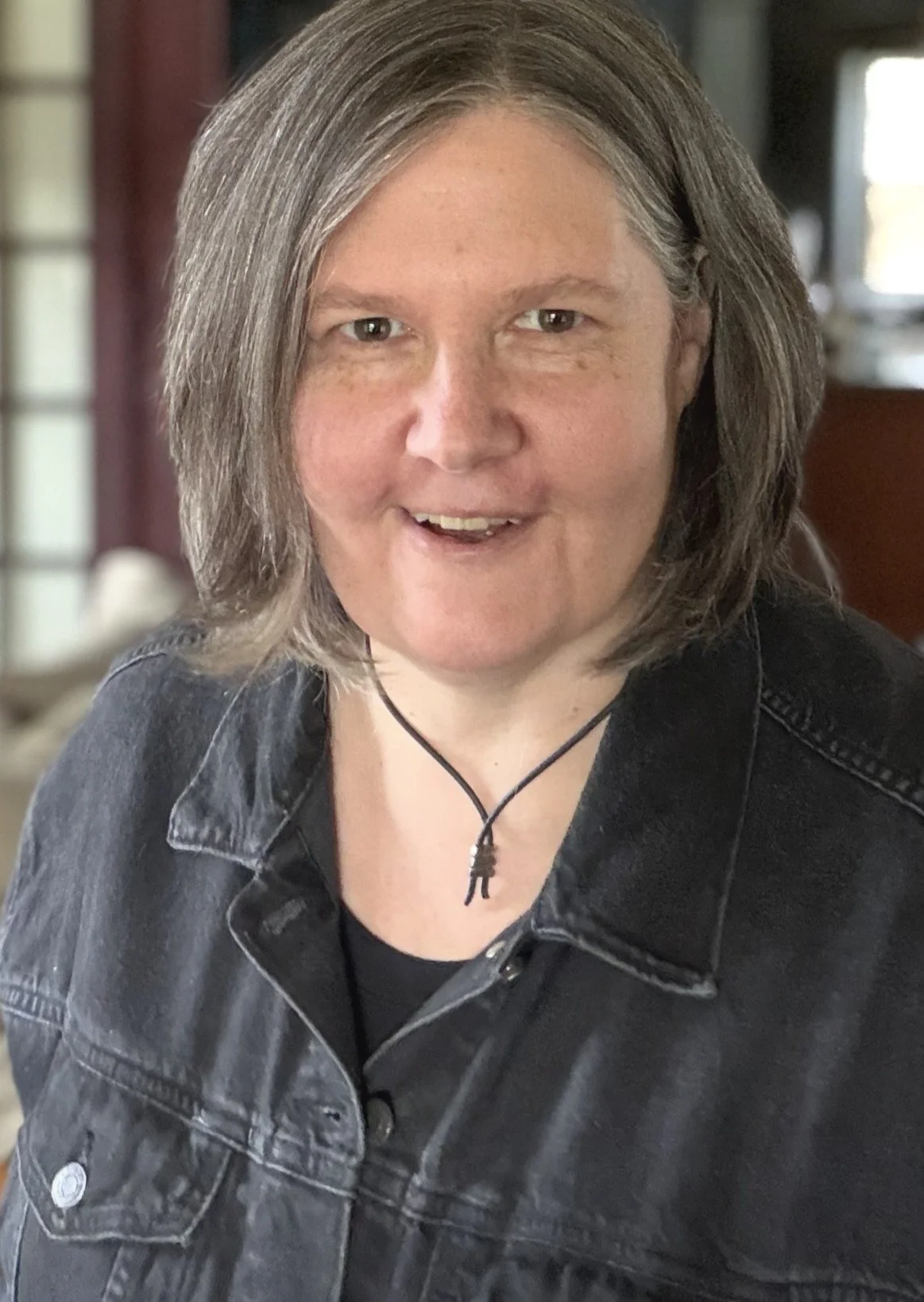
About me
This is a subject I’ve become so passionate about that I’m switching careers.
From medical communication to letterboard communication
My work as a creative director and designer, primarily for ad agencies, prepared me for this. Many of my projects have been in pharma, working with medical writers to explain the biology of medical conditions, why and how certain treatments work, and how they change lives.
Looking at nonspeaking as a medical condition, not an intellectual or motivational deficit, changes everything
Nonspeakers have neurodevelopmental sensory and motor-control complexity, not cognitive disabilities. Millions remain unknown as people because their thoughts and desired actions get sent to the movement centers of their brain, but the body can’t execute, leaving a tragic split between their intentions and what we see from the outside.
In all that I’ve read or seen by spellers, or those who live or work with them, I cannot shake this one thing. When a speller is finally able to share what they’re thinking, they all fire a flare into the air, something to the effect of: Now that you know I’m in here, help others like me.
Let’s work together
So, nonspeakers, I hear you. I’m a patient, compassionate, and hard-to-ruffle person, now educated in S2C and ready to help. Parents, caregivers, friends of nonspeakers: If you live within a reasonable distance of Newtown in Bucks County, PA, a little North of Philadelphia, not far from the NJ border, let's get your loved one spelling so that they can be truly known and participate in this life in the ways they want to.
If you’re not nearby, use the I-ASC Practitioner Finder
Or contact I-ASC to see if there’s a Practitioner in Training near you. We are not listed in the directory until we’re certified.
-
In 2021, thanks to a pediatric SLP's experiment with her own dog, I taught my dog a supplemental way to communicate. She can ‘say’ words.
Think of it as doggie AAC. Pets use floor buttons, like a human AAC user would press buttons on a tablet, minus the nested menus and keyboard features.
Why it matters: Not only is it how I got interested in human nonspeakers, but I also know that if my pets can use buttons to share a fraction of what’s on their minds and do it in surprisingly competent ways, then nonspeaking people deserve every possible effort from society to help them join the world of expressive thought.It’s a long read, but for the curious:
My dog Twiggy has paw-sized buttons arranged like a giant keyboard on our floor. When she presses one, a word floats up into the air. We started in 2021 with a few buttons and now have about 150. I’m an enthusiast, and so is she.It’s not just basic wants and needs.
She presses to add thoughts to my obvious action. She saw me putting on shoes, a sure sign I’m going somewhere, and added, “COME, MAYBE, GOODBYE? THANK YOU.” (Punctuation not included)
It’s a little like Yoda in that word order is mixed up, but I understood: Maybe I can come wherever you’re headed? Thank you in advance.
I said yes, she play bowed, barked, and I brought her with me.
Watch on InstagramReflection: Pleading eyes and whining could have done the job, but would I have known the depth? That she was thinking of it as a “maybe” just a suggestion, not a demand? Or that a “thank you” in advance of hearing a yes shows both optimism and eagerness?
It’s a way to add specificity to barking
Now this doesn’t always happen, but on great days, she’ll spare my ears and instead of bouncing her bark off the window, she heads to the buttons. She might press “ANIMAL” or “STRANGER” to request a second set of eyes on a trespasser. Or even use a species-specific button: SQUIRREL, DEER, RABBIT, BIRD. “Should we worry, human?” is how it feels, and I love being able to take a look and then tell her she can stand down.
Sometimes she doesn’t have the word she needs available as a button, so I’ve realized when she presses our “BUTTON” button, it’s a wildcard standing in for something that fits the context. For example, I verbally label all the animals we encounter, but she doesn’t have buttons for every species.
A bark accompanied by a “BUTTON” button press might mean she saw a fox or a groundhog outside. Irksome creatures for her, but not frequently seen, so I don’t think they’re worth turning into buttons.Here’s a compilation of 3 instances.
Reflection: When a nonspeaker wants to express alarm, pain, or even let someone know about a problem, how do they do it? If they have no reliable AAC, it’s similar to how my dog does. Using whatever is in her power to draw my attention to a situation. But when I follow her, and the thing she was upset about isn’t visible, whether because it’s gone or I just can’t see it, I’m left with a broad, “Oh, something must have upset her.”
In the wildcard instance, pressing BUTTON to mean, “I don’t have the button for the thing, so I’m just going to say thing,” that’s not something I taught. I only say or press “button” to refer to an actual button.If a dog can figure this out, that they can use a stand-in as a fill-in-the-blank, what are even intellectually disabled humans capable of?
To be clear, I stand firmly in the presume competence camp, where every human is fully capable of learning, even without explicit instruction or proof of what they know, and that every human is hungry for knowledge, especially those who have been deprived of education.
One more comment about the “BUTTON” button press: How frustrating must limited-word AAC be? Or knowing there’s a keyboard on a tablet but not having enough praxis (movement initiation and follow-through motor skills) to get there? Or not enough fine motor control to spell what you want to once you do get there? Or not have your high-tech AAC device’s volume be loud enough to get someone else’s attention?
Circling back to the barking comparison and how having buttons helps my dog add specifics, a human without access to a way to explain a problem, but only alert by making a ruckus or becoming visibly frustrated to solicit help, but not being able to add specifics, that’s injustice.
Why I’ve gone this deeply into pet vs nonspeaker and AAC-user comparisons, knowing it’s a deeply repulsive idea
Even if you know about button-using pets, unless you live with one who uses them in a sophisticated way, it’s impossible to understand the depth of what they do. The following things have happened in my home and others:
Pets processing confusion and grief over the loss of another pet or human loved one.
Pets using buttons for self-advocacy about illness or pain management.
Pets using words over actions when feeling aggressive
This is not to say that there’s a true parallel between my pets and those who rely on AAC.
A pet not being able to ‘speak’ is not a disabled pet. However, having buttons, if they like them and use them, is profoundly enabling.
Pets live perfectly happy lives as nonspeaking companions.
Pets are not fighting with disabled or disobedient, apraxic bodies. They have excellent aim with their paws for natural activities. Some do need practice learning the mechanics of button pressing.
Pets do have to be consciously taught language/words. They will pick up on some associations between what they overhear or are told and what it’s connected to, but it’s far different than natural and taught language acquisition in humans.
Here’s what is true: I believe every human can use words in a more sophisticated way than privileged household pets can use buttons.
My dog, and cats (yes, they press too), have me living this sci-fi life I never imagined but adore. I feel so much rage and injustice when I see how hard the nonspeaking community has to fight off skeptics, and worse, fight for the rights to use their preferred means of communication in schools. If systems like one person spelling on a letterboard or keyboard accompanied by a CRP (communication regulation partner) were more widely seen, there would be more parents willing to try and more systems in place for accommodation. And ultimately,
There are an estimated 31 million nonspeakers in the world. Things have to change.
To circle back to dogs, and a common objection, that nonspeakers should not need a human assistant with them while communication. It’s not that far removed from someone needing a guide dog. I know, now here I’m comparing humans to animals again, but it’s about support. That level of support is not something my dog, as smart as she is, could do. Plus, that role is the one I’m learning as an S2C Practitioner in Training, to make a difference for nonspeakers in my area.
—————A page full of facts on a site about the issues: United for Communication Choice
Communication4All’s C4A Network Advocacy Center